Wearable energy textiles are used to convert external energy, converting mechanical energy generated by human activities or energy generated by materials stimulated by external conditions into electric energy, which is of great significance in the current shortage of energy demand.Fiber flexible battery has the characteristics of light weight, flexibility and durability. It has a wide application prospect in energy textiles.However, in the actual application process, performance degradation or even failure due to extreme stretching, sharp bending or excessive distortion, etc., seriously hinders the further application of fiber flexible batteries in the wearable field.

To solve the above problems, the intelligent wearable technology research center of Qingdao university researchers inspired by biological structures of vines, we design a super stretch fiber with spiral structure the zinc ion battery (G/P - zinc @ SFB), they will be fiber cells with spiral structure tightly wrapped around the surface elastic silk, and made the fabric by the knitting process.A series of performance tests confirmed its potential in wearable energy textile applications.
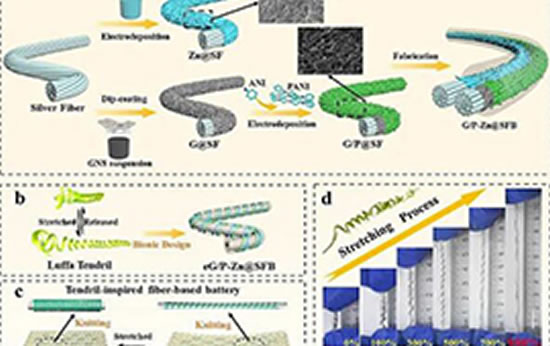
Electrochemical characterization results show that the ultratensile fiber wiki-zinc-ion battery has high specific capacity (32.56 mAh/cm3), energy density (36.04 mWh/cm3), excellent cycle stability (76.5% capacity after 1000 cycles), and Coulomb efficiency reaches about 100%.Moreover, the fiber-based zinc-ion battery retains 71

percent of its capacity when stretched to 900 percent.When released to the natural state, it also shows a retention rate of 84%.When the batteries are charged in series and connected to the red LED indicator, when the batteries are stretched to 900%, they can still efficiently supply power to the LED indicator, which indicates that the ultra-stretched zinc ion battery has excellent tensile resistance.
Finally, a smart wearable energy device was woven into a fabric of 18 series of ultra-stretch-fiber zinc-ion battery systems to power an LED device with a "QDU" logo.The results showed that the brightness of the QDU marker gradually dimmed as the elbow Angle changed from 0° to 180°.But when the bend Angle is 180°, the QDU still lights up, suggesting that the ultra-stretchable zinc-ion battery could be used as a powerful, ultra-elastic power source for flexible displays, wearable electronics and smart textiles.
In addition, the researchers combined a hyperstretched battery with an kummipael for lighting.Two batteries in series can be used to power the LED in static conditions.The LED light still glowed when the elastic band was pulled back, proving that the ultra-stretched fiber is highly stable and highly conductive than the zinc-ion battery.


Autoriõigus © 2019–2022 Zhejiang Leinuo Textile Technology Co., Ltd. Kõik õigused kaitstud. Privaatsustingimused Nõuded ja tingimused
 EN
EN  AR
AR NL
NL FR
FR DE
DE HI
HI IT
IT JA
JA KO
KO NO
NO PL
PL PT
PT RO
RO RU
RU ES
ES SV
SV ID
ID LV
LV LT
LT SR
SR SK
SK SL
SL UK
UK VI
VI TH
TH TR
TR FA
FA AF
AF MS
MS SW
SW GA
GA CY
CY BE
BE IS
IS MK
MK YI
YI HY
HY AZ
AZ EU
EU KA
KA HT
HT UR
UR BN
BN BS
BS CEB
CEB EO
EO GU
GU HA
HA HMN
HMN IG
IG JW
JW KN
KN KM
KM LO
LO LA
LA MI
MI MR
MR MN
MN NE
NE PA
PA SO
SO